
DRASH KI TISA
Rabbi Esther Jilovsky
Rabbi Dr Esther Jilovsky
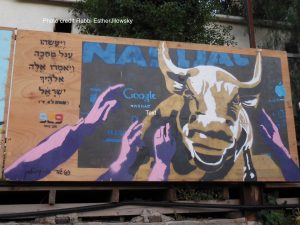
I took this photo on a trip to Israel back in July 2015. It’s a billboard in Jerusalem, and I loved the way it juxtaposes a Torah quote with a modern interpretation of its meaning. The verse on the billboard reads:
וַֽיַּעֲשֵׂ֖הוּ עֵ֣גֶל מַסֵּכָ֑ה וַיֹּ֣אמְר֔וּ אֵ֤לֶּה אֱלֹהֶ֙יךָ֙ יִשְׂרָאֵ֔ל
‘and he [Aaron] made it into a molten calf. And they exclaimed, “This is your god, O Israel!”’ (Sh’mot 32:4)
On the billboard, the calf lurches out of the frame, a smug expression hovering upon its bovine lips. Unembodied hands reach up towards it. Behind them, radiant blue logos of tech giants including Google and Apple, float against a black background. Could this image suggest that our modern attachment to smartphones might be equivalent to creating and worshipping a golden calf?
The Torah quote comes from this week’s parasha, Ki Tissa. The setting is Mount Sinai, and it’s about three months since Moses led the people of Israel out of Egypt. Three months since the sea split so that the Israelites could walk across on dry land. Three months since the people of Israel reached freedom. Now, they’re camped around the base of Mount Sinai, waiting for Moses to come down from the peak. He’s been up there for a while. Moses is taking his time, and the people are getting impatient:
וַיַּ֣רְא הָעָ֔ם כִּֽי־בֹשֵׁ֥שׁ מֹשֶׁ֖ה לָרֶ֣דֶת מִן־הָהָ֑ר
‘The people saw that Moshe was late descending from the mountain’ (Sh’mot 32:1)
Instead of waiting for Moses to come down from Mount Sinai, the people take matters into their own hands. Rather than waiting for Moses to return, the people turn to Aaron, his deputy and brother. They ask him to make a physical ‘god’ and Aaron complies. The people contribute their gold jewellery, Aaron pours it into a mould, and voila, a physical ‘god’ to worship (Sh’mot 32:2-4). A golden calf! An idol – a form of worship explicitly forbidden in the Ten Commandments.
But, it’s also an understandable and very human response to the frustration of indefinite waiting. Like waiting to board a delayed flight, without knowing the new departure time or whether the flight will still operate, or be cancelled. It’s much easier to deal with definite information, such as a three-hour delay, than a non-specific ‘delay’ that promises only more uncertainty.
When Moses comes down the mountain and sees the Israelites worshipping the golden calf, he is so furious, he smashes the stone tablets that God has just given him (Sh’mot 32:19). Moses’ anger is also understandable. The people that he had been deigned to lead had blatantly flouted the Ten Commandments – and the whole thing was orchestrated by his brother. Yet, taking out his own frustrations at his people by smashing the holy tablets that God had given him is not a healthy or productive way to deal with anger.
In both passages, emotions are heightened. The frustration almost leaps off the page. The endless waiting and the absence of leadership and certainty leads to the creation of a physical yet idolatrous presence. Leaders aren’t perfect. But good leadership requires clear communication. If Moses knew he would be up the mountain for forty days and forty nights, perhaps it was a good idea to make sure the people of Israel knew this, before he shlepped all the way to the top. Conversely, if the Israelites were impatient because they didn’t know when Moses was coming back, perhaps they could have tried to find out how much longer he would be, before embarking on the drastic step of creating a fake physical ‘god’ that directly contravened the Ten Commandments.
I photographed this billboard because I loved how it made the Torah seem relevant to today. But now I wonder if the message is much deeper. It’s not easy being a leader. It’s easier to build a golden calf and distract people with shiny things that fall apart very quickly. It’s much harder yet ultimately more satisfying to win back the trust of people you have let down. It’s much easier to keep staring at your phone open that new app, swipe to another photo, scroll to the next notification than to actually use it to make a phone call and talk to someone. It’s easier to reach for the golden calf, than to wait for Moses to return with the tablets. And if we can’t take our eyes off the golden calf, or can’t switch off the smartphone, we may never know the price we pay for our lack of patience to engage with what’s around us.
Find more Parashat Hashavua